




How to price catering per person, and show it on your online menu
Price a catering tray from what it costs you, then show the per-person price on your menu. A step-by-step guide with the math and a sample screen.


Key takeaways
- To price a catering tray, add the cost of the food, the packaging and the pack-out labor, then divide by the share of the price you want your costs to take.
- Price the tray you cook, such as one that serves 12, and show the per-person price next to it, because the buyer is dividing a budget by a headcount.
- Keep delivery, sales tax and tip on separate lines at checkout so the menu price stays the tray price.
- Smaller trays cost more per person because every tray still needs a lid, a label and someone to pack it.
To price a catering tray, add up what it costs you in food, packaging and pack-out labor, then divide that total by the share of the price you want your costs to take. Show the answer as the tray price with the per-person price next to it. That is the number the buyer is trying to work out anyway.
A common shortcut is to take a menu price and multiply it by the headcount. That number leaves out the box, the utensils and the time someone spends packing the order. On a big order, the missing costs add up.
How do you work out the price of a catering tray?
Cost the whole tray first, then price it. Follow these five steps in order.
- Cost the food. Add up the ingredients for one whole tray, using what you paid for them.
- Add the packaging. Count the pan or box, the lid, and any napkins, plates, utensils and serving tools you include.
- Add the pack-out labor. Time how long it takes to prep, portion, pack and label one tray, then multiply by the hourly cost of the person doing it.
- Divide by your cost share. Pick the share of the price you want your costs to take. If you want costs to be half of the price, divide the total cost by 0.50. If you want them to be 40 percent, divide by 0.40.
- Divide the tray price by the number of people it serves. The result is the per-person price you show.
Your accountant can tell you what share of your menu price your costs take today. Decide whether catering should match that share or sit higher, because a catering tray has pack-out work that a table order does not.
Delivery is not in these steps. It gets its own line, covered below.
What does that look like with real numbers?
The table runs the same five steps for three tray sizes. Every number in it is made up to show the math, so swap in your own costs.
| Tray | Food | Packaging | Labor | Total cost | Tray price | Per person |
|---|---|---|---|---|---|---|
| Serves 6 | $21.00 | $4.00 | $10.00 | $35.00 | $70.00 | $11.67 |
| Serves 12 | $42.00 | $6.00 | $15.00 | $63.00 | $126.00 | $10.50 |
| Serves 24 | $84.00 | $10.00 | $25.00 | $119.00 | $238.00 | $9.92 |
Example only, not a benchmark. Food is $3.50 a person. Labor is 30, 45 and 75 minutes at $20 an hour. The tray price is the total cost divided by 0.50, so costs are half of the price.
Take the tray that serves 12. Food at $42.00, packaging at $6.00 and labor at $15.00 add up to $63.00. Divided by 0.50, the tray price is $126.00. Divided by 12 guests, that is $10.50 per person.
Why does the per-person price drop on bigger trays?
Food grows with the headcount, and the other costs do not. The food costs the same per guest in every tray, $3.50 in this example. A tray for 24 has twice the food of a tray for 12, but it does not need twice the packaging or twice the labor. In the table, the tray for 6 comes to $11.67 per person and the tray for 24 to $9.92.
Our take: do not set one per-person rate and multiply it by any headcount. Sell the tray sizes your kitchen really cooks, and let each size carry its own per-person price.
Where do delivery, sales tax and tip go?
Each one goes on its own line at checkout, outside the tray price. The tray price then stays the same for every buyer, and the delivery line can change with distance. To set that line, read how much a restaurant should charge for delivery.
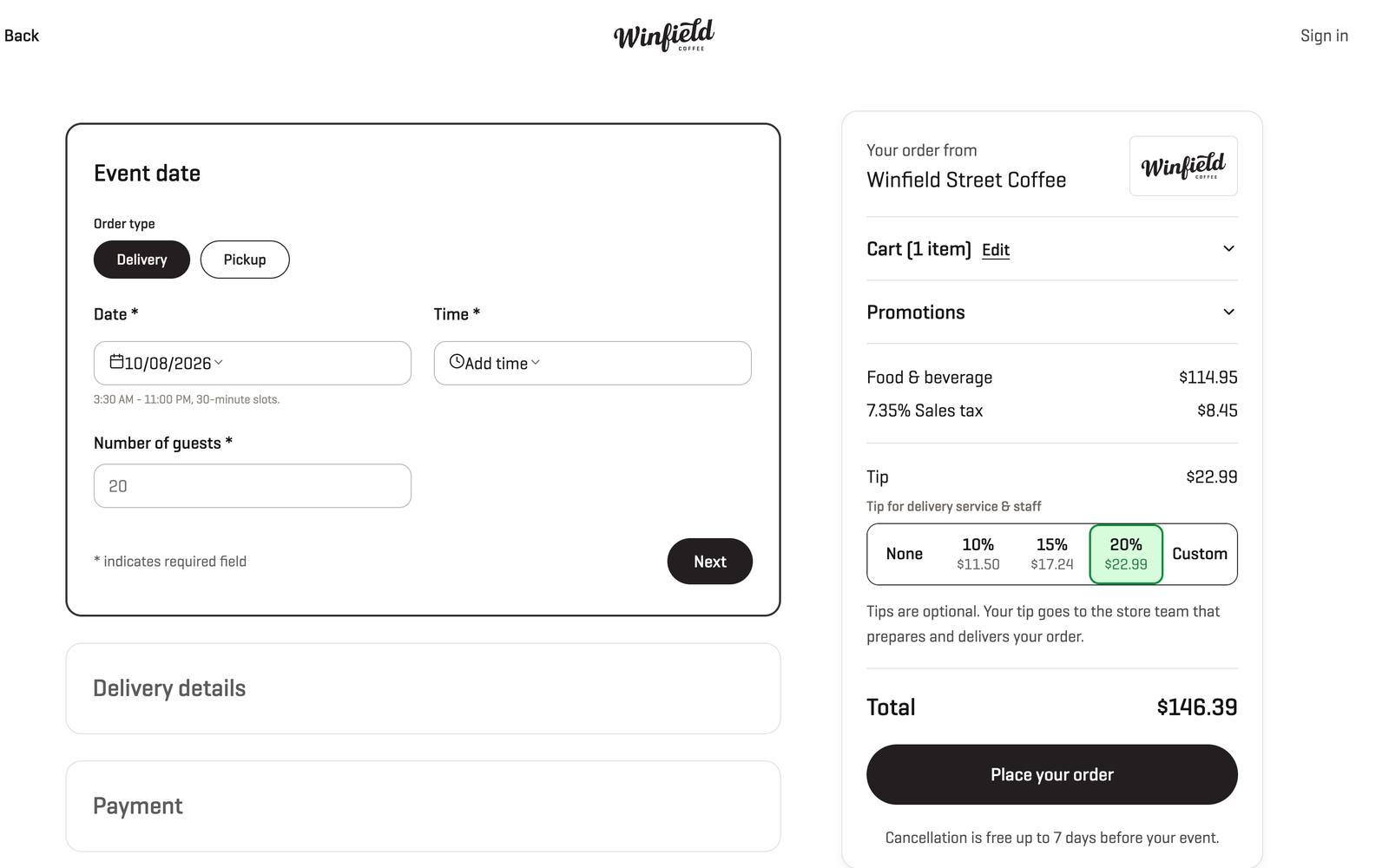
Tax rules depend on your state and on how the order is delivered. Ask your accountant how to treat the delivery charge and the tip before you set them up in your register.
How should the price show on your online menu?
Put the serving size and the per-person price right under the tray price. A buyer is usually dividing a budget by a headcount, so show the division already done. For the rest of what a catering page needs, read how to get more corporate catering orders for your restaurant.
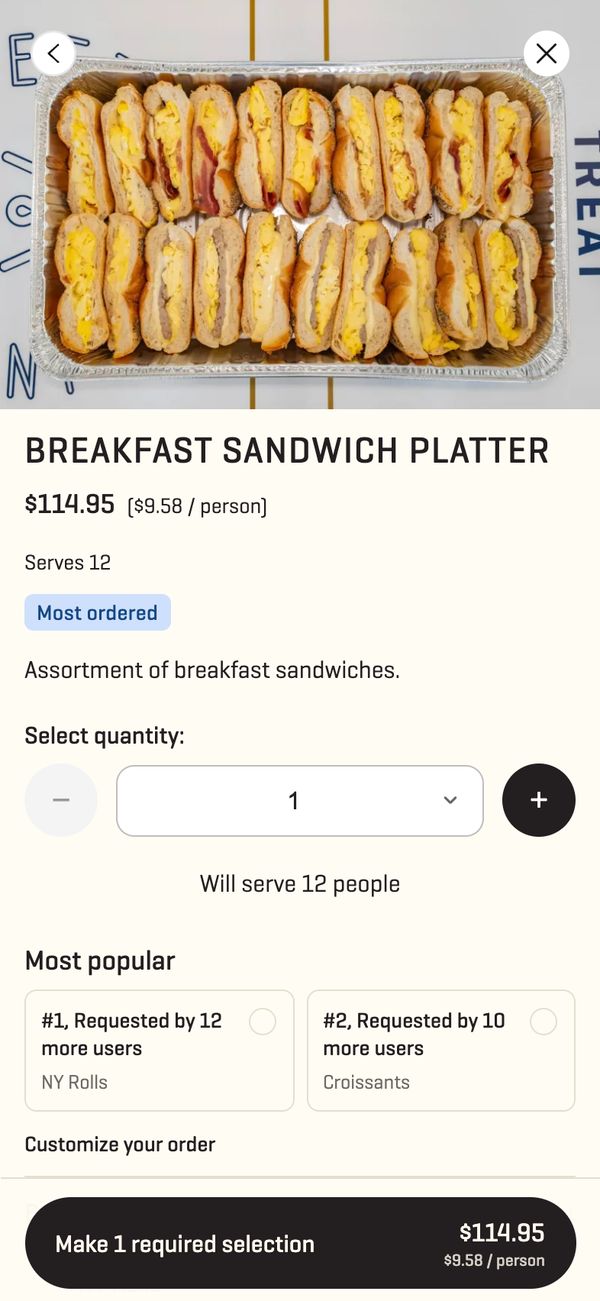
On the catering sites we build, each tray shows its serving size and its per-person price, and the button that adds it to the cart repeats both. The buyer does not need a calculator to compare trays.
Our take: a price with no serving size sends the buyer to the phone. A price with one can be forwarded to whoever approves the budget.
How do you check a price before you publish it?
Run your last three catering orders through the five steps and see what share of the price your costs really took. If it is higher than the share you chose, raise the tray price or trim what goes in the tray. The per-person price follows from the tray, so change the tray first.
Then round the tray price to a clean number, such as $126 instead of $125.40, and let the per-person price follow. Redo the check whenever a main ingredient or your hourly labor cost moves enough to change the cost of a tray.
What mistakes leave catering underpriced?
- Multiplying a dine-in menu price by the headcount, which skips the box, the utensils and the pack-out time.
- Costing the tray from ingredient prices you paid months ago.
- Leaving out the labor of packing and labeling because it happens in a rush before the driver leaves.
- Giving every tray size the same per-person price, so the small trays leave you less than the big ones.
- Folding delivery into the tray price, so a nearby order pays for a far one.
Can your online menu show all of this?
If your ordering page cannot show a serving size and a per-person price yet, that is the part we build. For Winfield Street Coffee we made a catering ordering site where each tray shows both and where food, tax and tip stay on separate lines. You can see the details in the Winfield Street Coffee case and on our catering ordering page.
Frequently asked questions
Should I price catering per person or per tray?
Per tray, with the per-person price shown next to it. The tray is what your kitchen cooks and packs, and the per-person number is what the buyer compares against a budget.
How should I price a gluten-free or vegan swap?
As an add-on on the tray. Use the extra cost of the swapped ingredients and the extra handling, and label the item so the buyer can see what changed.
How often should I change my catering prices?
When an ingredient or your hourly labor cost moves enough to change the cost of a tray. Recheck your five best-selling trays every month and the rest every season.
What if my costs rise after a buyer has already ordered?
Keep the price the buyer saw at checkout and change the menu for new orders. A price that moves after the order is placed costs you the buyer's trust.


Comments