


ezCater dispatch fee or your own driver? The math on a $500 catering order
ezCater's dispatch fee is $30 up to a $300 order and 10% above it. See the break-even table and how to price one run with your own driver.

Key takeaways
- ezCater's page lists a dispatch fee of $30 for an order subtotal up to $300 and 10% for a subtotal above $300.
- Your own driver is cheaper whenever one run costs you less than that fee, so a $500 order breaks even at $50.
- Above a $300 subtotal the fee rises with the order, and below it the flat $30 is 20% of a $150 order.
- Time ten runs with your own driver, then compare each one with the fee for that order size.
ezCater’s dispatch service costs a restaurant $30 on an order subtotal up to $300 and 10% of the subtotal on orders above $300, according to ezCater’s own page. Your own driver is the cheaper choice whenever one run costs you less than that fee, so a $500 order breaks even at $50.
This guide gives you the fee table, a way to price one run of your own, and the orders where each option wins. It covers the dispatch fee only. Other ezCater charges are not part of this comparison.
How much does ezDispatch cost a restaurant?
ezDispatch is ezCater’s delivery option for catering orders. Its fee has two tiers. The page lists “Order subtotal up to $300 = $30 Dispatch fee” and “Order subtotal more than $300 = 10% Dispatch fee”. We read the 10% as applying to the whole order subtotal, which is how the table below counts it.
The page also says “You keep the delivery fee from the customer (less applicable fees).” It does not say which fees are applicable. Check the delivery line in your ezCater payment breakdown before you count on the customer’s delivery fee to cover any of the dispatch fee.
The page shows no update date, only a 2026 copyright line, so we read it on November 27, 2026. Read it again before you build a plan on these numbers.
What does that fee look like on real order sizes?
Up to $300 the fee is flat, so a small order pays the biggest share. Above $300 it is 10%, so the fee grows with the order.
| Order subtotal | Dispatch fee (your break-even per run) | Share of the order |
|---|---|---|
| $150 | $30 | 20% |
| $250 | $30 | 12% |
| $300 | $30 | 10% |
| $500 | $50 | 10% |
| $1,000 | $100 | 10% |
The math is $30 divided by the subtotal for the first three rows, and 10% of the subtotal for the last two. Read the middle column as the price of one run. If your own driver can make that run for less, you keep the difference.
Our take: above $300, the fee grows with the order, while your driver’s time depends mostly on the distance. A $1,000 order costs $100 to dispatch, and the drive to the same office can take as long as the drive for a $300 order. Loading takes longer on the big order, so count that time too. This is where your own driver is most likely to pay off.
At $300 and below, your driver only has to beat $30. That works when the stop is close to the store. It is hard when the stop is far, or when you would have to call a driver in for a single run.
What does one run with your own driver cost?
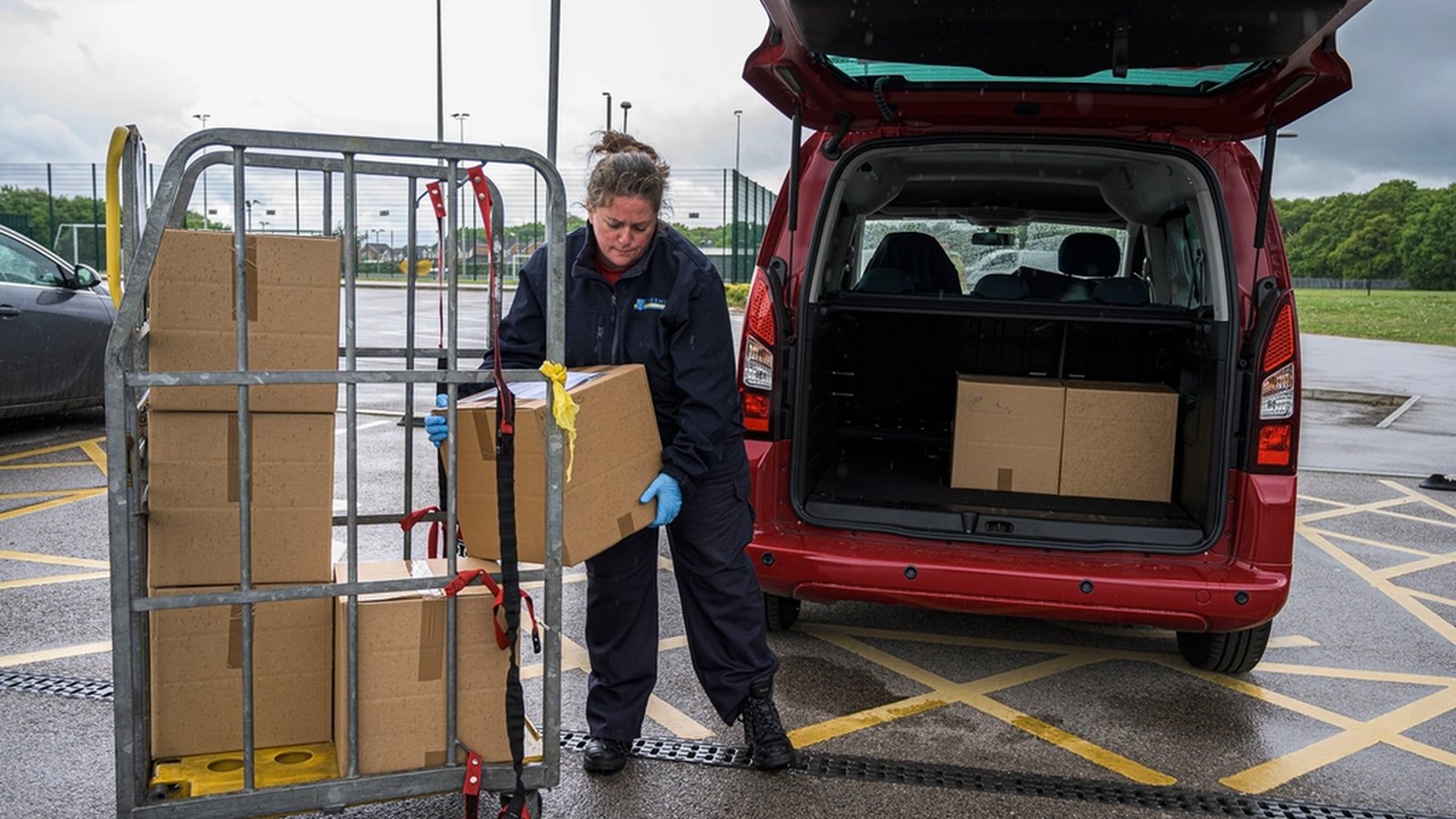
A catering run starts at the loading counter and ends back at the store, so price all of it. It takes longer than dropping a bag at a door, and the extra time is where owners undercount. The driver loads trays and a chafing kit, finds the entrance or the loading dock, and carries everything in, often past a front desk or a security check. Then comes the setup in the meeting room, and sometimes a wait for the person who has to sign. Sometimes the driver brings empty trays back to the store.
None of this shows up in a map estimate of the drive, and all of it is paid time. Use five steps to put a number on it:
- Time the run from the first tray loaded to the driver walking back in. A phone clock works, and so does a driver app that records the delivery time.
- Multiply that time by what the driver costs you per hour, including payroll taxes and insurance.
- Add the vehicle: the miles driven times your own cost per mile.
- Add the waiting you pay for around the run, such as a driver standing by while the order finishes packing.
- Compare the total with the dispatch fee for that order size.
Time ten runs before you decide. An average by order size is a better guide than one good or bad day.
When is ezDispatch the better choice?
It is the better choice when you cannot send your own driver at a sensible cost. Four common cases:
- You have no driver on the schedule at that hour, such as an early breakfast drop or a late event.
- The address is far from the store, and the run would pull your driver away from the next order.
- Two big orders are due in the same window and you have one driver.
- Your driver called out.
In those cases the fee buys a run you could not make otherwise. A late lunch can cost you the buyer’s next order. For a corporate account, that is worth weighing against the fee.
What should you ask ezCater before you rely on dispatch?
The fee section lists a price. Four questions about the service around it are still open. Get written answers before you send a big corporate order through dispatch:
- Is dispatch chosen order by order, or for the whole listing?
- What happens if the delivery is late, and who do you call?
- Who covers a missing or damaged tray?
- Does the fee change if the customer moves the delivery window?
The fee section we read does not cover any of these. If you plan to use both options, the first question decides whether you can.
How do you run your own drivers on ezCater orders without a second screen?
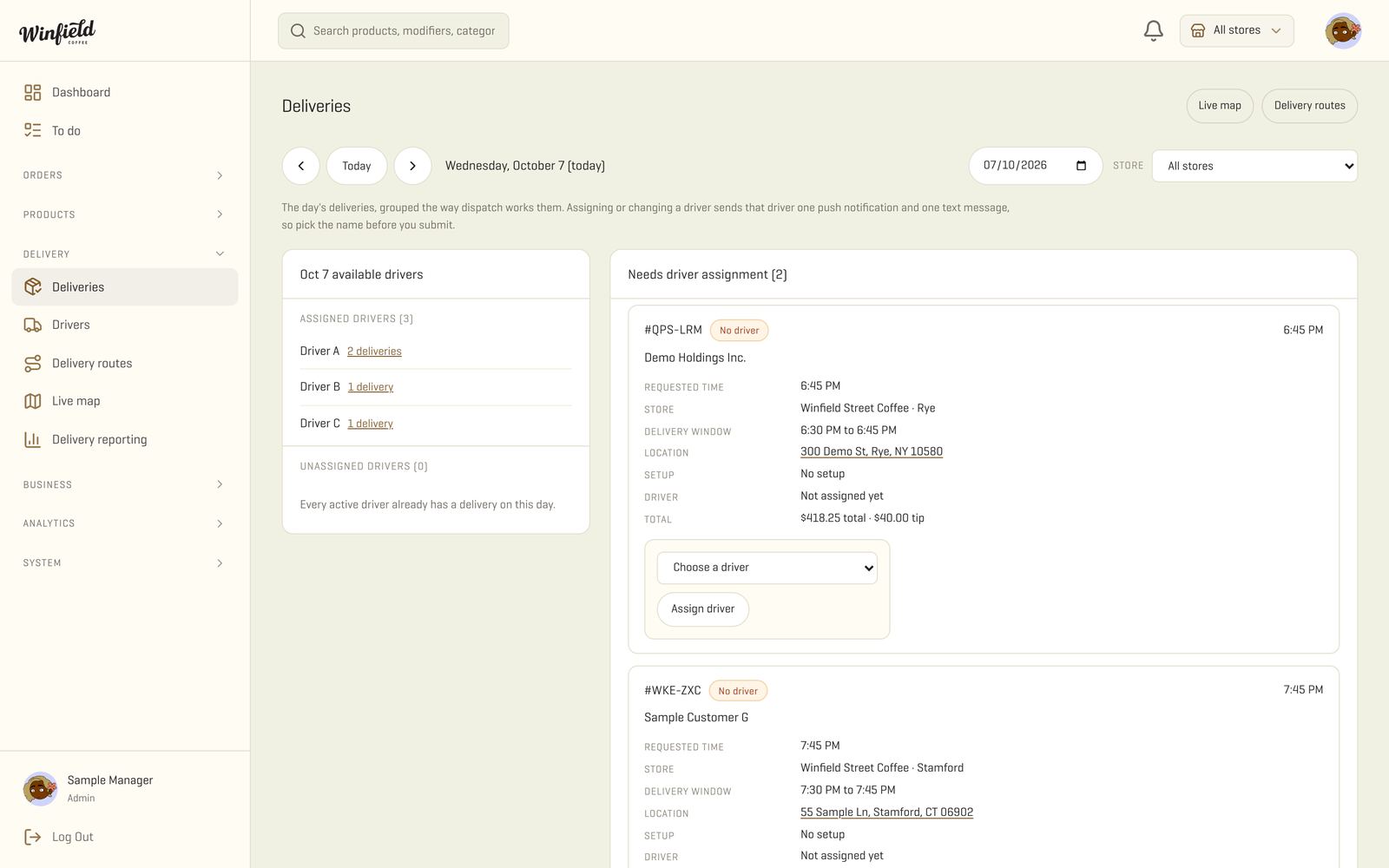
You need one list that shows every delivery still waiting for a driver, with the delivery window and the address, and a way to pick a driver from it. Our delivery driver app and dashboard work this way, and we work with ezCater’s API, so ezCater orders and direct orders land in the same list.
In the Winfield Street Coffee build, ezCater orders go out with the chain’s own drivers, and the driver’s progress goes back to ezCater as the delivery moves.
Two related guides cover the details. How to get ezCater orders into Clover explains how the order reaches your register and how driver status goes back. Proof of delivery for restaurants covers the item check and the photo at the door.
What should you do this week?
- Pull your last ten ezCater deliveries and match each subtotal to the table.
- Time your next ten runs with your own driver and price them with the five steps above.
- Set a rule by order size, such as your own driver on your usual routes and dispatch for the rest, and write it down for your managers.
For the wider question of in-house drivers against on-demand services outside ezCater, read own drivers or on-demand delivery. To set what a customer pays for delivery on your own site, see how much a restaurant should charge for delivery.
Frequently asked questions
How much does ezDispatch cost a restaurant?
ezCater's page lists a $30 dispatch fee for an order subtotal up to $300 and a 10% fee for a subtotal above $300. It also says the restaurant keeps the customer's delivery fee, less applicable fees.
What does ezDispatch cost on a $500 catering order?
It is 10% of $500, which is $50. If one run with your own driver costs you less than $50, your own driver is the cheaper option for that order.
Does the dispatch fee apply to small orders too?
Yes. Up to a $300 subtotal the page lists a flat $30, which is 20% of a $150 order and 12% of a $250 order.
How many of my own runs should I time before comparing?
Ten is a workable start. It gives you an average for each order size, so one slow day does not decide the question.
Sources
- ezCater, Delivery solutions (dispatch fee) · Nov 27, 2026
Comments