Own drivers or on-demand delivery? Cost and control, side by side
In-house drivers or third-party delivery? Here is the real cost of each, what you keep from a $40 order, and how to pick for your restaurant.

Key takeaways
- In-house delivery is a restaurant running its own drivers and its own dispatch, instead of handing every order to a third-party app.
- A $40 marketplace order can hand back 15% to 30% in commission before the restaurant pays a driver at all.
- Own drivers pay off when the delivery shift stays full. Three or more deliveries per hour beats almost every third-party plan.
- On-demand delivery (DoorDash Drive, Uber Direct) sits in the middle: a flat $7 to $11 per order, with the customer still on your site.
In-house delivery is a restaurant running its own drivers and its own dispatch, instead of handing every order to a third-party app. For most independent restaurants, the honest answer is a mix: own drivers for the orders you can predict, on-demand for the rest, and the marketplace apps as a billboard, not as the home of your regulars.
The hard part is deciding which order belongs to which lane.
What does in-house delivery actually mean?
In-house delivery means three jobs stay with the restaurant: taking the order on a channel you own, assigning a driver you employ, and running the delivery under your brand. The order enters your system, your staff dispatches a driver on payroll, and the bag at the door has your logo on it.
Third-party delivery hands all three jobs to someone else: the customer, the driver, and the data about the order. Most restaurants we work with use both. The question is which orders should go through your own drivers, and which should go through someone else.
How much do the big delivery apps charge today?
On the marketplace side, the two biggest apps publish tiered commissions tied to how much visibility a restaurant gets.
DoorDash lists three plans for Marketplace orders, with 15% commission on the Basic plan, 25% on Plus and 30% on Premier. Pickup is 6% on all three plans. DoorDash Drive, where the customer orders on your own channel and a Dasher delivers it, is a flat $6.99 to $10.99 per order (RestoLabs guide, updated July 27, 2026, citing DoorDash merchant pricing).
Uber Eats restructured its fees on March 11, 2026. The Lite tier moved from 15% to 20%, Plus stayed at 25% (and 30% for orders from Uber One members), and Premium remained at 30%. Pickup rose from 6% to 7% with validated in-store pricing. Uber Direct, the on-demand version where the customer orders on your site, starts at $7.99 per order (QSR Pro coverage of the fee restructure, April 2026).
These rates sit on top of the subtotal. Taxes and the delivery fee the customer pays are outside the commission. The number that lands in your bank account is lower still, after the processing fees come out.
What does a $40 order look like on each model?
A single order makes the differences concrete. The table assumes a $40 food subtotal, before tax, tip and delivery fee.
| Delivery model | Fee on the subtotal | What you keep from $40 | Who owns the customer |
|---|---|---|---|
| DoorDash Marketplace, Basic | 15% | $34.00 | DoorDash |
| DoorDash Marketplace, Plus | 25% | $30.00 | DoorDash |
| DoorDash Marketplace, Premier | 30% | $28.00 | DoorDash |
| Uber Eats Marketplace, Lite | 20% | $32.00 | Uber Eats |
| Uber Eats Marketplace, Premium | 30% | $28.00 | Uber Eats |
| DoorDash Drive (your site, their driver) | $6.99 to $10.99 flat | about $29 to $33 | You |
| Uber Direct (your site, their driver) | from $7.99 flat | about $32 | You |
| Your own driver | fixed hourly cost plus mileage | depends on volume | You |
Three things stand out. The marketplace plans leave you with the smallest piece of the subtotal, and someone else keeps the customer. The on-demand options (DoorDash Drive and Uber Direct) land close in cash to a Marketplace Basic plan, but the order sits in your system and the next one does too. Your own driver only pays off when the shift stays busy.
When do your own drivers pay off?
A driver on payroll turns delivery from a per-order cut into a fixed cost. The math is simple: hourly wage, plus mileage reimbursement, plus insurance, divided by the number of deliveries that fit into the shift.
The real question for the hourly driver is whether the shift stays full. Three or more deliveries per hour, and the per-order cost of your own driver undercuts almost every third-party model. One or two per hour, and the fixed cost eats the margin fast.
Signals that in-house delivery earns the operation:
- A core delivery radius inside about three miles, with recurring neighborhoods and repeat customers.
- Lunch and dinner peaks that run two hours or more, several nights a week.
- A catering or large-order flow where the delivery is part of the brand, not a stranger in a jacket from an app.
Where own drivers struggle: late night, long-distance one-offs, and the hour between the lunch rush and the dinner build. That is where the on-demand options earn their keep.
Where on-demand delivery fits
On-demand delivery is the middle lane. The customer orders on your site, pays you, and gets a driver from a third-party fleet. DoorDash Drive and Uber Direct are the two biggest. The cost is a flat fee per order, so you can decide which orders are worth it.
Three practical uses:
- Covering the hours your own driver is off the clock, without turning down the order.
- Reaching outside your in-house radius for a known good customer.
- Catering runs that cannot fit on the shift schedule you already have, without exposing the account to a marketplace listing.
The commission math changes too. A $40 order with a $7.99 Uber Direct fee leaves about $32 on the table, close to a Marketplace Lite plan, with the difference that the customer and the order history stay with you.
What a hybrid setup looks like
Most restaurants we work with run all three channels through one screen. The deliveries queue shows every order waiting for a driver, your own drivers logged in for the shift, and the ones routed through an on-demand service.
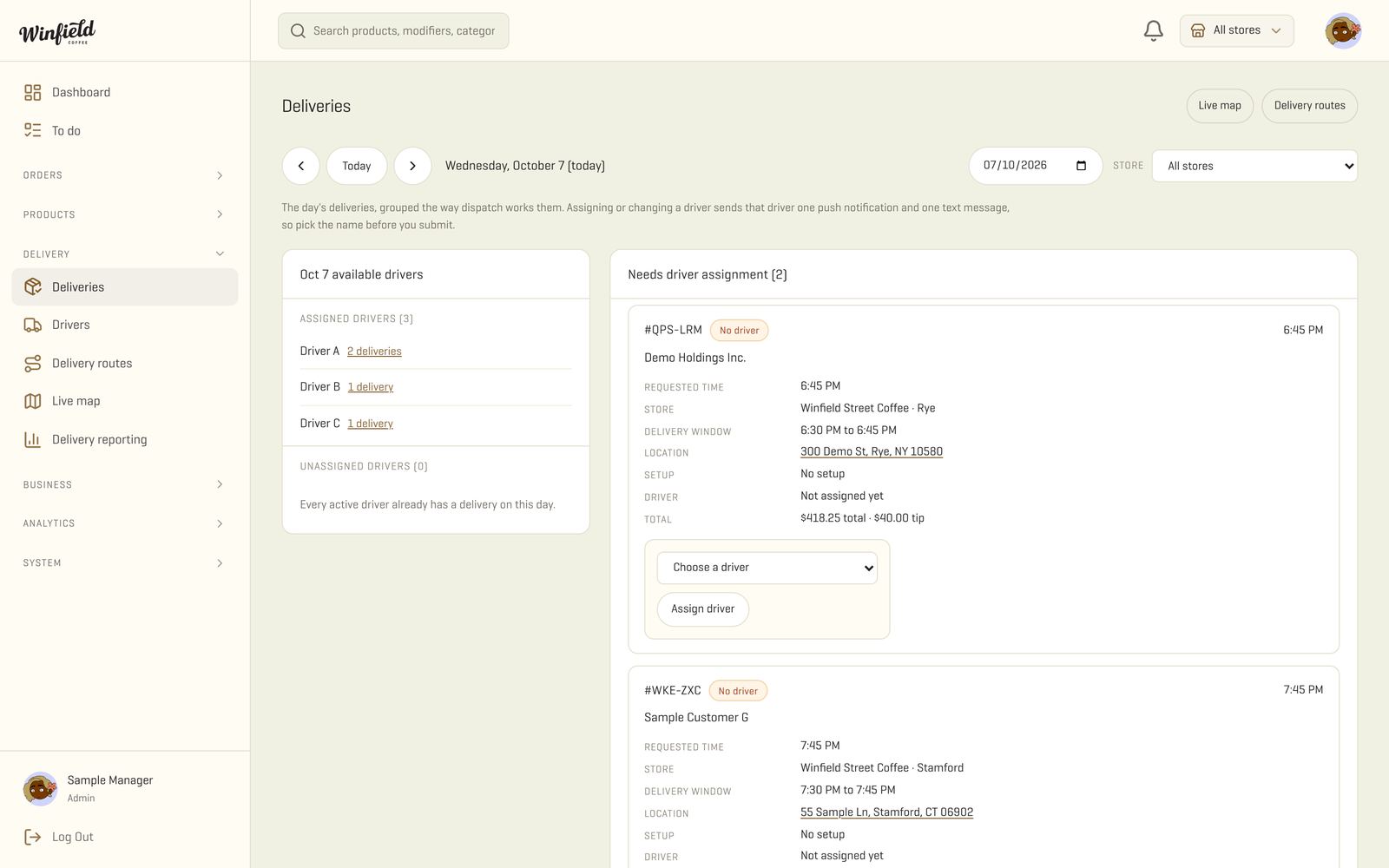
Three details matter inside that screen:
- One place to see which order is late, no matter which driver has it.
- An auto-rule that pushes orders to DoorDash Drive or Uber Direct when no in-house driver is free, with a per-order ceiling the owner sets.
- A customer tracking link, the same for every delivery, so the calls asking where the order is stop coming in.
That is the version of in-house delivery that pays off. The older version, where every delivery has to go through the restaurant, breaks the first time two drivers call out on a Friday.
If this looks like how your delivery should run, our driver app and live map service page walks through the pieces, and our commission-free online ordering guide covers the site that feeds the queue.
Our take
Pick the model per order, not per restaurant. The marketplace apps are a billboard: good for finding a new customer once, poor as the home of your regulars. Your own drivers are a payroll decision tied to the shape of your week. On-demand delivery is a safety net, not a plan.
The restaurants that keep delivery profitable almost never run a pure in-house operation, and almost never give the whole channel to an app. They keep the queue in one screen, pay their own drivers for the busy windows, and let the on-demand services clean up the edges. The customer never knows the difference, and the margin shows up where it belongs.
Frequently asked questions
How many deliveries per hour does an in-house driver need to beat a 25% commission on a $40 order?
On a $40 order, 25% is $10. If a driver costs about $20 per hour loaded with mileage and insurance, two deliveries per hour matches that commission. Three or more, and the own driver wins.
Can I use my own site and third-party drivers at the same time?
Yes. DoorDash Drive and Uber Direct both let a restaurant hand off individual orders from its own site to their fleet, with a flat fee per order instead of a percentage.
Do I need a separate app for my drivers?
A branded driver app is the simplest way to run it. The driver sees the next delivery, the manager sees the live map, the customer sees the tracking link. One system, three screens.
What about orders outside my delivery area?
Set an in-house radius in the dashboard. Orders outside that radius route automatically to the on-demand service, so you decide which deliveries belong to your drivers.
Sources
- RestoLabs, DoorDash fees for restaurants guide · Jul 27, 2026
- QSR Pro, Uber Eats fee hike March 2026 · Apr 1, 2026

Comments