Commission-free online ordering: how restaurants bring regulars to their own site
Commission-free online ordering sends paid orders straight into your POS, with no cut per order. Here is how to bring your regulars to your own site.

Key takeaways
- Commission-free online ordering is a restaurant site that takes orders and payments without a marketplace taking a cut of each one.
- A marketplace is a tool for new customers; your own site is where repeat customers should come back.
- A paid monthly price for the site is the same whether you take ten orders or a thousand, so the margin returns as volume grows.
- Start with pickup from a QR code and the printed menu, and keep the marketplace open for discovery.
Commission-free online ordering is a restaurant site that takes orders and payments directly, without a marketplace taking a cut of each one. The simplest way to make it work: keep the marketplaces for new customers, and send repeat customers to a site with your name on it, where every dollar stays with you.
That second part is where most restaurant pages lose the money. The link to the online menu points to the app, not to the restaurant.
What does “commission-free online ordering” actually mean?
A commission-free ordering system has one invoice per month, not one deduction per order. You pay a flat price for the site and the processor fee on the card. There is no per-order percentage that scales with your sales.
A delivery marketplace does the opposite. The commission is charged on each order, published on the partner pricing page of each platform, and the better the restaurant sells, the more it pays. The marketplace also keeps the customer. You are not paying to be chosen; you are paying for a listing on a page where other restaurants show up right next to yours.
An owner on the Square Seller Community put the same tension in a simpler sentence in February 2026: online ordering was built for takeout, so “lead times, pickup/delivery availability, fees & gratuities” make a regular cart “unusable” when the order grows. The same shape of problem shows up on everyday orders: the small ones that leave in a bag at the counter and the ones that fill the Monday lunch service.
Why do regulars still order on the app?
Because that is where their phone takes them. The customer who ordered once on DoorDash saved the restaurant inside the app, not on the home screen. The next time they want the same lunch, two taps find it, the card is already there and the delivery address is already saved.
Your own site, if it exists, is a Google search away. The menu takes four seconds to load. The hours live on a different page. The old online ordering link goes to a form.
The money follows the convenience. We see the same pattern when we review restaurant and cafe sites: a page that could pay for itself in a week sits one click deeper than the app that charges a commission.
How do you move repeat customers to your own site?
Start with the orders you can win first. These are not the new customers scrolling the app at 7 pm; these are the people who already ate at your place and liked it.
- Put the ordering link where the customer already looks. The link in your Instagram bio, the QR code on the table, the sticker on the window, the printed menu, the sign on the pickup counter. All of them point to your site, not to the app.
- Make the first order on your site a small push, not a lecture. A short line on the receipt: “Order online next time, 5% off, scan this.” A dollar off a $20 pickup is less than any marketplace commission.
- Save the order. The second time the customer opens the site, their last order is right there with a one-tap “Order again.” That is how the app wins today; a site can do the same.
- Charge the card where they already pay. The paid order should land in your POS, so the register prints the ticket and the daily sales report has every dollar in one line.
- Keep delivery honest. If you deliver yourself, show the fee. If you use an on-demand service for the last mile, show the fee for that too. A $4.99 delivery fee on your site is easier to defend than a $12.78 total that nobody understands.
- Keep the marketplace open for discovery. New customers find you on the app; the second order is where you take over. The goal is not to disappear from the marketplace; it is to not depend on it.
What should a commission-free ordering site look like?
It has to feel as light as the app. A customer who waits five seconds for the menu to load will go back to the app the next day.
A few things we check on every build:
- The menu loads under two seconds on a mid-range phone, even on the first visit.
- The customer can pay with Apple Pay or Google Pay in two taps.
- The site remembers the address, the phone, the last order and the card. Nothing to type the second time.
- The order lands in the POS already paid, with the item modifiers and the pickup time next to the ticket.
- The tax and the tip are added at checkout, so the number the customer sees is the number they pay.
- The receipt sends a short email that invites the next order.
| Marketplace order | Commission-free order on your site | |
|---|---|---|
| Who the customer is | the marketplace’s | yours |
| Who sets the price shown | the marketplace | you |
| Who takes a cut per order | the marketplace, per the partner pricing page | nobody (you pay the processor fee) |
| Where the payment lands | the marketplace’s deposit | your POS, in your bank account |
| Where the order enters the kitchen | tablet | the register you already use |
| What the customer sees next week | a page with ten restaurants | your site with “Order again” |
Our take: own the channel your regulars use
The per-order fee is only part of the cost. The real cost is losing the next order to a page where another restaurant shows up above yours. A site a customer saved on their phone is paid for once; it doesn’t bid against you every lunch.
We built Winfield Street Coffee a direct ordering site for catering, with payments landing in each store’s register and one dashboard for every order. The dashboard looks like this:
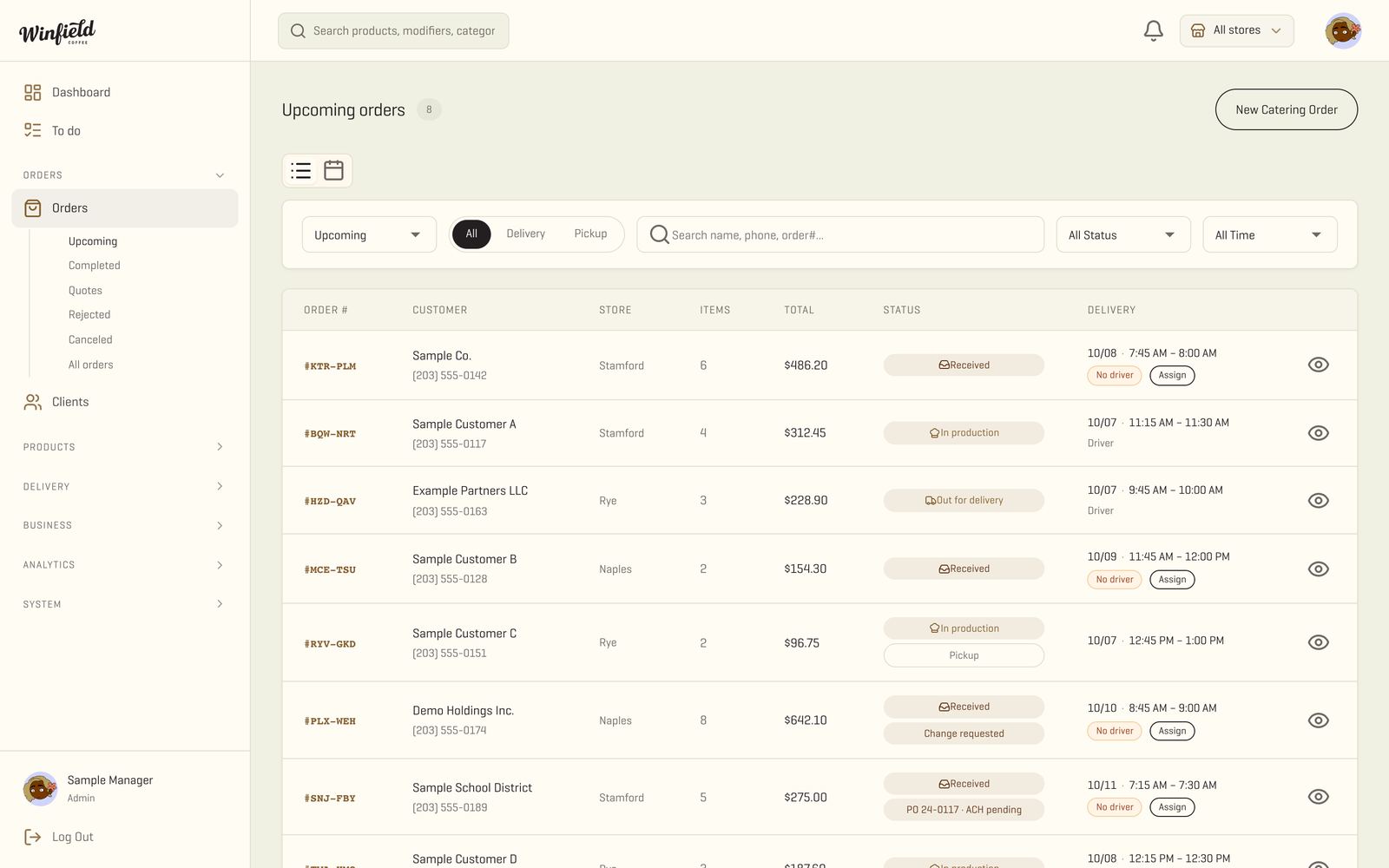
The piece that keeps the dashboard honest is the one most restaurant teams skip: every order, from the ordering site and from the marketplace that still sends orders, in the same list. Two sources, one screen, same labels on the ticket. The team doesn’t learn two tools and the kitchen doesn’t ask which app the order came from. If you take catering too, our longer guide on how to take catering orders online covers the event-date fields, the lead time and the approval step that catering needs on top of a regular ordering site.
A direct ordering site is also a page the customer can save. The second order is a tap, not a search. The third is habit. That is what a commission-free site is really buying you: a chance at the second order and the third, instead of paying for the first every time.
What about delivery when you go commission-free?
Delivery is the piece that most owners worry about the day they turn on their own site. The honest answer is that it has three paths, and the right one depends on how many orders you already send out the door.
- Pickup only on your site at first. No delivery driver, no third-party fee, no dispatcher. Pickup pays for the site on its own.
- Your own drivers for catering and long distances. You already pay a driver for the Monday corporate lunch; a branded driver app shows the order, the stops and the proof of delivery, and the customer sees a live tracking link instead of a phone call.
- On-demand delivery for peak hours. Services that charge a flat fee per delivery (not a cut of the ticket) can plug into your site and send a driver when your own driver is busy.
The point of a commission-free site is not to never pay for delivery. It is to pay once, per order, a known amount, instead of a percentage that scales with every success. The National Restaurant Association’s 2026 report describes a sector where traffic has grown slower than costs; a channel that doesn’t cost more as it grows is where the margin returns.
If you want a quick look at where your site is losing to the app today, our team runs a free assessment on your current online ordering flow: the links in your bio, the QR code on the table, the pages the second order lands on, and what a commission-free setup would change for your margin.
Frequently asked questions
Does commission-free mean no cost at all?
No. You pay for the site and the payment processor, usually a flat monthly price plus a card fee. The difference is that the monthly price stays the same whether you take ten orders or a thousand.
Should I remove my restaurant from DoorDash or Uber Eats?
Not right away. Marketplaces are a cheap way to be seen. The move is to make the second order from the same customer happen on your site.
Can my current POS take orders from my own site?
Yes. A direct ordering site can send paid orders into the POS you already run, such as Clover, Square or Toast, so sales and tax reports stay in one place.
How long does it take to launch an online ordering site?
Ours go live in up to 30 days, already taking orders, starting with one store.
Will a commission-free site hurt my ranking on delivery apps?
No. Marketplaces rank by sales and reviews, not by whether you also sell on your own site.
Sources

Comments